
手搖飲一杯接一杯,總是停不下來?這背後藏著「液態糖」的陷阱,讓血糖狂飆、糖癮難戒。膳食纖維能從機制層面阻擋糖吸收,幫助你穩定血糖、告別焦慮。
手搖飲為何像「糖炸彈」?
現代人愛手搖飲,一杯微糖珍奶或水果茶常含20-35克糖,直接達到或超過一整天WHO的建議攝取量。這些糖多為液態形式,如葡萄糖和果糖,不像固態食物有纖維緩衝,直接衝進小腸被快速吸收,導致血糖指數(Glycemic Index, GI)飆升。人體試驗顯示,喝含糖飲料後,血糖峰值可在30分鐘內升高20%,遠高於固態碳水化合物。

液態糖特別危險,因為它繞過飽足訊號,大腦獎賞系統釋放多巴胺(Dopamine),形成類似成癮的迴圈。 持續累積,不只引發胰島素阻抗,還增加第二型糖尿病(T2DM)風險25~35%。對有基礎知識的大眾來說,這就像高速公路上的液態糖,毫無阻礙直達肝臟,造成脂肪堆積和發炎。
糖癮機制:大腦為何「上癮」?
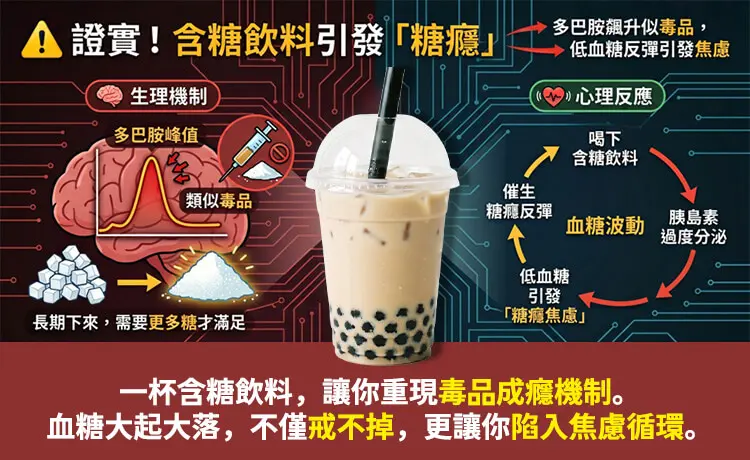
糖癮不是意志力問題,而是神經生物學現象。液態糖刺激腹側被蓋區(Ventral Tegmental Area, VTA)釋放多巴胺,產生快感。研究顯示,頻繁攝取高GI液態糖,可能會影響大腦前額葉皮質與杏仁核(Amygdala)的功能,進而導致衝動控制能力失調。 人體實驗證實,喝含糖飲料後,多巴胺峰值升高類似毒品,長期下來,需要更多糖才滿足。這解釋手搖飲戒不掉:血糖波動引發低血糖反彈,催生「糖癮焦慮」。
膳食纖維:糖吸收的「物理屏障」
膳食纖維分可溶性和不可溶性,不可溶性促腸道蠕動,可溶性更關鍵,能吸水成凝膠,增加腸內容物黏度。這機制阻擋液態糖:延緩胃排空,減緩澱粉酶活性,阻礙葡萄糖經SGLT1(Sodium-Glucose Linked Transporter 1)轉運器吸收。
科學家解釋,黏性可溶性纖維形成「物理屏障」,降低營養物與腸絨毛接觸,延緩葡萄糖擴散。對液態糖尤其有效,因為它們無天然纖維,單獨攝取時吸收率高達95%,與膳食纖維一同食用後後降至70~80%。
科學數據說話:纖維如何降血糖峰值?
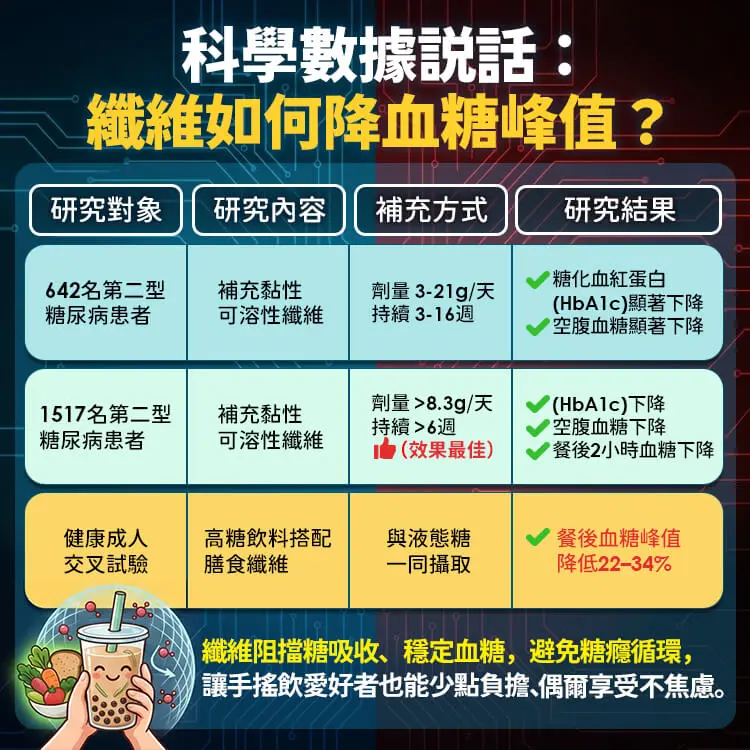
多項隨機對照試驗證實膳食纖維對液態糖的阻擋效果。642名T2DM患者補充黏性可溶性纖維(劑量3-21g/天,持續3-16週),糖化血紅蛋白(HbA1c)和空腹血糖顯著下降。
另一個研究,1517名T2DM成人,水溶性纖維補充顯著降低HbA1c、空腹血糖、2小時餐後血糖。分析顯示,劑量>8.3g膳食纖維/天、持續 >6週效果最佳。
針對液態糖,一項交叉試驗、健康成人喝高糖飲料加膳食纖維,餐後血糖峰值降22-34%。
纖維阻擋糖吸收後,血糖曲線變平穩,能避免多巴胺過度釋放,斷開糖癮鏈,對手搖飲愛好者,纖維提供「緩衝」,讓偶爾的享用不焦慮。
穩定血糖,找回生活掌控
膳食纖維從機制阻擋液態糖,讓血糖不再狂飆,糖癮焦慮自然消退。專業數據顯示,黏性可溶性纖維是第二型糖尿病的管理利器,劑量8-10g/天、持續6週以上,能有效降低代謝指標。
瞭解這些,你能透過「第一口吃纖維」更有信心面對手搖飲的糖陷阱。
參考文獻
- Lu, K., Yu, T., Cao, X., Xia, H., Wang, S., Sun, G., Chen, L., & Liao, W. (2023). Effect of viscous soluble dietary fiber on glucose and lipid metabolism in patients with type 2 diabetes mellitus: A systematic review and meta-analysis on randomized clinical trials. Frontiers in Nutrition, 10, Article 1253312.
- Xie, Y., Gou, L., Peng, M., Zheng, J., & Chen, L. (2021). Effects of soluble fiber supplementation on glycemic control in adults with type 2 diabetes mellitus: A systematic review and meta-analysis of randomized controlled trials. Clinical Nutrition, 40(4), 1800-1810.
- Liu, Y., et al. (2024). Dietary fiber interventions on glycemic control and weight management in diabetes: A systematic review. Cureus, 17(2), e78497.
- Estrada, A. C. P., et al. (2022). The effects of soluble dietary fibers on glycemic response: An overview and future directions. Nutrients, 14(23), 5099.
- Zhao, L., et al. (2018). Fiber intake and glycemic control in patients with type 2 diabetes mellitus: A systematic review and meta-analysis of randomized controlled trials. PLoS ONE, 13(12), e0208931.
- Vuksan, V., et al. (2014). Randomized clinical trial in healthy individuals on the effect of viscous fiber blend administered with or without food on postprandial glycemia. Food & Function, 5(11), 2760-2765.
- Anderson, J. W., et al. (2004). Effect of soluble fiber intake in lipid and glucose levels in healthy subjects. Diabetes Care, 27(7), 1749-1751.
- Zurbau, A., et al. (2021). Double-blind RCT on viscous fiber blend in type 2 diabetes. Journal of Functional Foods, 82, 104489. (Cited in )
- McRorie, J. W., Jr., & McKeown, N. M. (2017). Mechanisms of viscous, soluble fiber effects. Nutrition Today, 52(3), 113-122. (Mechanistic review with clinical data)
- Maki, K. C., et al. (2007). Comparable postprandial glucose reductions with viscous fiber blend enriched biscuits in healthy subjects and patients with diabetes mellitus: Acute randomized controlled clinical trial. Current Medical Research and Opinion, 23(12), 3087-3094.